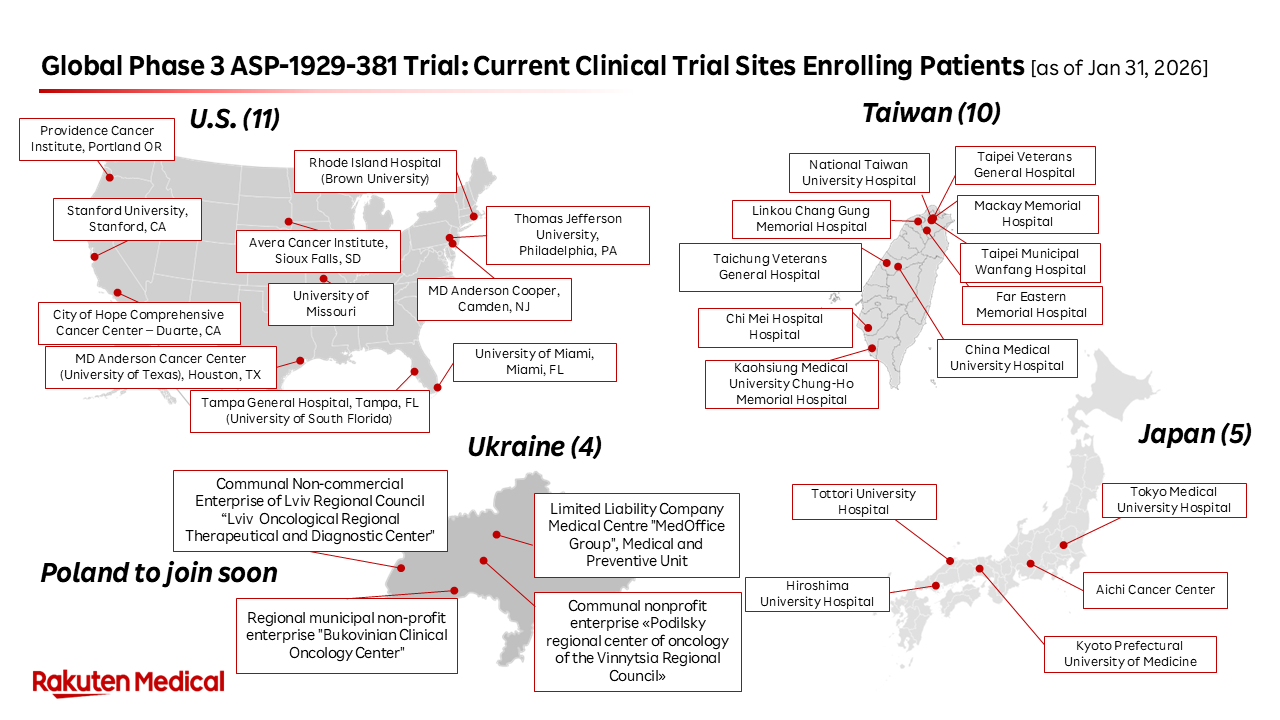
- 30+ sites across the U.S., Taiwan, Japan and Ukraine are now actively recruiting patients
- Additional site activations planned, including in Poland
- BLA submission to the U.S. FDA targeted for 2028
San Diego, CA — Feburary 18, 2026 — Rakuten Medical, Inc., a global biotechnology company developing and commercializing Alluminox® platform-based photoimmunotherapy, today announced that the first patient in Ukraine has been treated under the Company’s ongoing global Phase 3 clinical trial, ASP-1929-381 (NCT06699212). The study is evaluating ASP-1929 photoimmunotherapy in combination with pembrolizumab as a first-line therapy for patients with recurrent head and neck squamous cell carcinoma (HNSCC).
Currently, over 30 clinical sites across the United States, Taiwan, Japan and Ukraine are actively recruiting patients. Additional sites are expected to be activated in these regions, as well as in Poland.
This global Phase 3 trial builds upon encouraging data from an interim evaluation (data cut-off: April 30, 2024) of 19 patients enrolled in the HNSCC cohort of the Phase 1b/2 study ASP-1929-181 (NCT04305795), which evaluated ASP-1929 photoimmunotherapy in combination with anti-PD-1 including pembrolizumab. Findings showed early efficacy signals, particularly a median overall survival (OS) of 25.6 months, and a generally manageable safety profile. In addition, exploratory biomarker analyses suggested that the combination therapy may increase anti-tumor immunity at the targeted lesion.
Arman Kacharian, MD, Medical Director of the National Cancer Institute of Ukraine, who supported the initiation of this global Phase 3 trial in Ukraine, commented:
“The initiation of this Phase 3 trial in Ukraine is an important step forward for our oncology community and, most importantly, for patients facing recurrent head and neck cancer. Even under the extraordinary challenges of wartime, Ukraine remains committed to advancing evidence-based, innovative cancer care. We particularly appreciate Rakuten Medical’s readiness and confidence to conduct clinical research in Ukraine despite the ongoing war. Such commitment demonstrates true partnership and trust in the professionalism and resilience of Ukrainian clinicians and researchers. Through this collaboration, we are working to bring cutting-edge therapies into clinical practice, strengthen our research infrastructure, and expand access to new treatment options for Ukrainian patients who urgently need them.”
To mark this milestone, principal investigators (PIs) from the four active sites in Ukraine shared the following comments:
Olena Zhurakivska, MD in the Department of Chemotherapy with Day Patient Care, Podilsky Regional Oncology Center of the Vinnytsia Regional Council:
“Participation of Ukraine and especially our center in Vinnytsia in this landmark Phase 3 study fills us with profound optimism. For patients with head and neck cancer in our country, where treatment options can be severely limited, photoimmunotherapy emerges as a beacon of innovative science. This targeted approach holds the potential to address critical unmet medical needs by offering a novel mechanism of action. We are proud to contribute to these global efforts, bringing hope and cutting-edge clinical research directly to our patients.”
Yaroslav Shparyk, MD in the Chemotherapy Department, Lviv State Oncological Regional Treatment and Diagnostic Center:
“Despite aggressive treatment, many patients with head and neck cancer experience disease recurrence, often locally. In these cases, available drug therapies, including pembrolizumab, are largely palliative and rarely deliver meaningful survival benefit. Rakuten Medical’s ASP‑1929 photoimmunotherapy represents a novel approach with the potential to address this unmet need. We are pleased to participate in this Phase 3 clinical trial to help evaluate its potential.”
Anna Pidverbetska, MD in the Bukovinian Clinical Oncology Center in Chernivtsy:
“Participation of Ukraine and particularly our Chernivtsi center in this pivotal Phase 3 trial instills deep hope within our team. For subjects battling head and neck malignancies across our nation—where therapeutic alternatives often remain scarce—photoimmunotherapy represents a potential breakthrough in targeted oncology. This innovative modality shows promise in tackling pressing medical gaps through its unique biological pathway. Contributing to this worldwide scientific endeavor brings us immense pride, as we deliver tomorrow's treatments to today's patients right here in our community.”
Veronika Patsko, MD in the Medical Centre MedOffice Group / National Cancer Institute in Kyiv:
“Taking into account the very difficult situation at this time, it is very important to have such modern treatment for Ukrainian patients as photoimmunotherapy. Both oncologists and patients might be confident not being alone in their fight against head and neck cancer”
About ASP-1929-381 Study
The ASP-1929-381 study is a multi-regional multi-center, randomized, open-label Phase 3 trial, designed to assess the efficacy and safety of ASP-1929 photoimmunotherapy in combination with pembrolizumab as a first-line treatment for locoregional recurrent HNSCC without distant metastases. 412 patients globally will be randomized to either an experimental arm receiving ASP-1929 photoimmunotherapy in combination with pembrolizumab, or a control arm receiving the current pembrolizumab-based standard of care (SOC), where patients may receive pembrolizumab alone or in combination with chemotherapy according to the physician's choice.
The primary endpoint is Overall Survival (OS), with key secondary endpoints including Complete Response Rate (CRR) and Overall Response Rate (ORR).
Disclaimer: Rakuten Medical’s Alluminox platform-based photoimmunotherapy is investigational outside Japan.
About Rakuten Medical, Inc.
Rakuten Medical, Inc. is a global biotechnology company developing and commercializing Alluminox® platform-based photoimmunotherapy, which, in pre-clinical studies, has been shown to induce rapid and selective cell killing. Rakuten Medical’s photoimmunotherapy is currently investigational outside Japan. Rakuten Medical is committed to its mission to conquer cancer by developing its pioneering treatments as quickly as possible to as many patients as possible all over the world. The company has offices in 5 countries/regions, including the United States, where it is headquartered, Japan, Taiwan, Switzerland and India. For more information, visit www.rakuten-med.com.
About Alluminox® platform
The Alluminox® platform is Rakuten Medical’s investigational technology platform that combines pharmaceuticals, medical devices, medical technology, and other peripheral technologies. Rakuten Medical is developing Alluminox platform-based photoimmunotherapy, which involves two key steps: 1) drug administration and 2) targeted illumination using medical devices. The drug component consists of a cell-targeting moiety conjugated to a light-activatable dye, such as IRDye® 700DX (IR700), that selectively binds to the surface of targeted cells, such as tumor cells. The device component consists of a light source that locally illuminates the targeted cells with red light (690nm) to transiently activate the drug. Rakuten Medical’s pre-clinical data have shown that this activation elicits rapid and selective necrosis of targeted cells through a biophysical process that compromises the membrane integrity of the targeted cells. Therapies developed on the Alluminox platform may also result in local and systemic innate and adaptive immune activation due to immunogenic cell death of the targeted tumor cells and/or the removal of targeted immunosuppressive cells within the tumor microenvironment. Photoimmunotherapy was originally developed by Dr. Hisataka Kobayashi and his team at the National Cancer Institute in the United States. Outside Japan, Rakuten Medical’s Alluminox platform-based photoimmunotherapy is investigational.
About ASP-1929
Rakuten Medical’s first pipeline drug developed on its Alluminox® platform is ASP-1929, an antibody-dye conjugate comprised of the anti-epidermal growth factor receptor (EGFR) antibody cetuximab and IRDye® 700DX, a light activatable dye. ASP-1929 binds to EGFR, a cancer antigen expressed in multiple types of solid tumors, including head and neck, breast, lung, colorectal, prostate and pancreatic cancers. After binding to cancer cells, ASP-1929 is locally activated by illumination with red light (690 nm), emitted by a laser device system to produce a photochemical reaction. This reaction is believed to cause damage to the membrane of cancer cells, leading to selective necrosis of cancer cells. In Japan, ASP-1929 received marketing approval from the Japanese Ministry of Health, Labor, and Welfare for unresectable locally advanced or recurrent head and neck cancer in September 2020, under the Sakigake Designation System and the Conditional Early Approval System. ASP-1929 photoimmunotherapy in combination with pembrolizumab is currently under investigation in a global Phase 3 clinical trial as a first-line therapy for recurrent head and neck cancer. Outside Japan, ASP-1929 has not yet been approved for commercial use by any regulatory authority.
Media & Investor Contact:
Ai Yoshikawa
Associate Director, Global Corporate Communications & Investor Relations
Tel: +81-(0)70-4196-0845
Email: [email protected]